Will Patrick Reed make the US Ryder Cup team?

Screenshot

Patrick Reed won his first LIV event in Dallas at the weekend. This brings up the delightful possibility that he may be part of the US Ryder Cup team. Europeans rejoice!

US Ryder Cup Captain Keegan Bradley has said “I want the 12 best players regardless of tour affiliation”. So with Patrick’s continuing run of good form he may well be part of their team which would inject an element of toxicity into the team room. With not just the LIV affiliation but also the controversies and conflicts years before this could be a dangerous proposition for the Americans.

Keegan Bradley himself is in superlative form winning on tour a fortnight ago and the prospect is there that he could be a playing captain. Keegan has his issues, having been overlooked as a player in 2023 because as he sees it “he wasn’t part of the boys network”.

This time the PGA of America may suggest that he plays and hands over the captaincy to deputy Jim Furyk with the oportunity tocaptain hw team at a later date. The Europeans, whose possible team looks very strong, will be salivating at all this disruption.

.•.

Posted in Uncategorized | Leave a comment

Still no progress on PGA Tour/LIV Merger

Screenshot

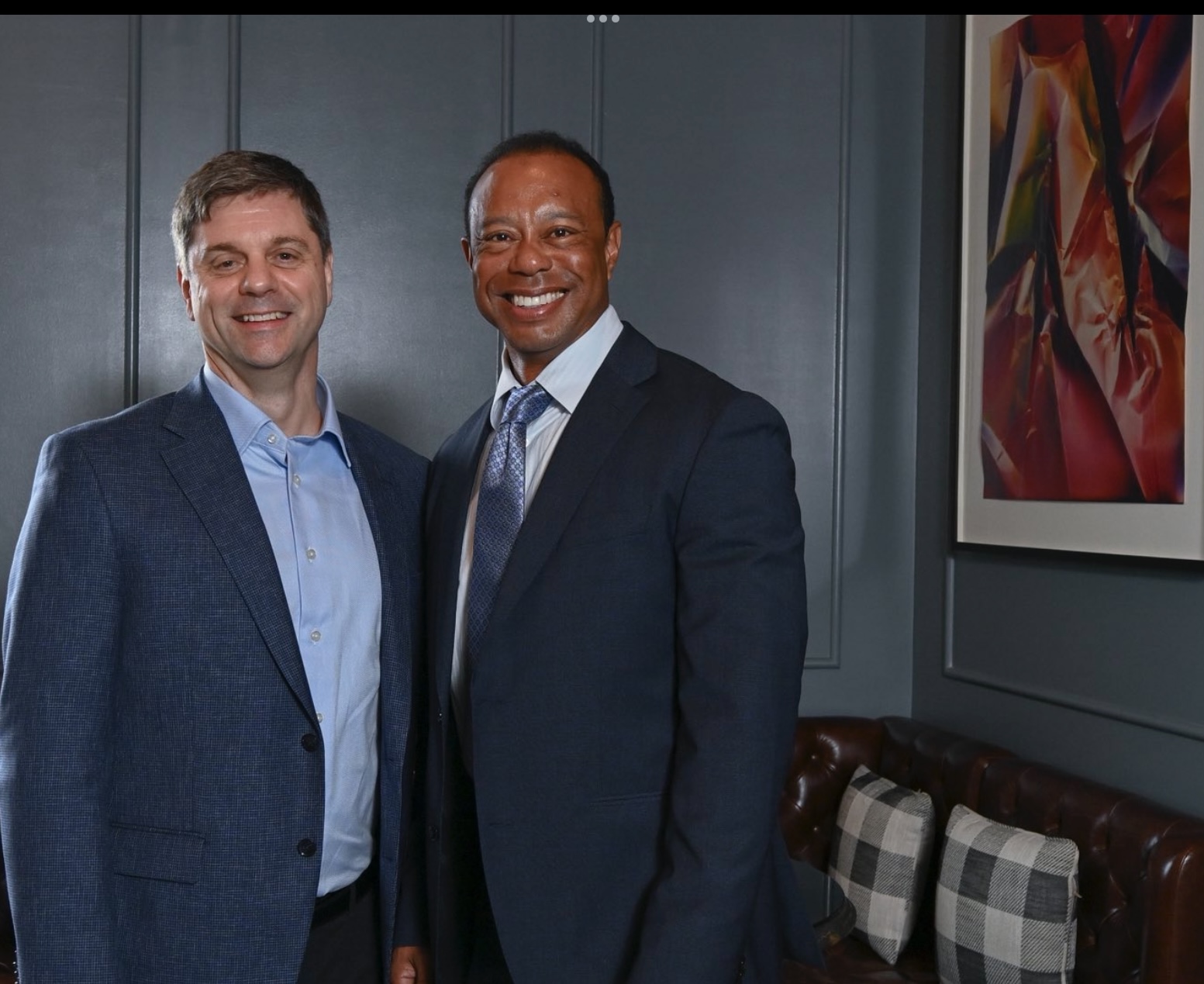
Brian Rolapp (left with Tiger), the new PGA Tour CEO designate met with players at the Rocket Mortgage Classic in Detroit last week.

Previously the NFL’s Chief Media and Business Officer, he got a positive reception from the players one of whom described hom as “an outsider trying to figure things out, but a switched on guy”.

It seems that players were informed that the situation with LIV is still at a stalemate, a year on from the shock decision to merge the two tours.

Talks with the Public Investment Fund of Saudi Arabia remain at a standstill with he PGA Tour not wanting to take on the team concept.

Where will this all be in another year?

Posted in Uncategorized | Leave a comment

Aldrich Potgieter wins his first PGA Tour title

Screenshot

Yesterday was one of those rare

“Hello World” moments when a huge takent becomes a winner on the PGA Tour for the first time.

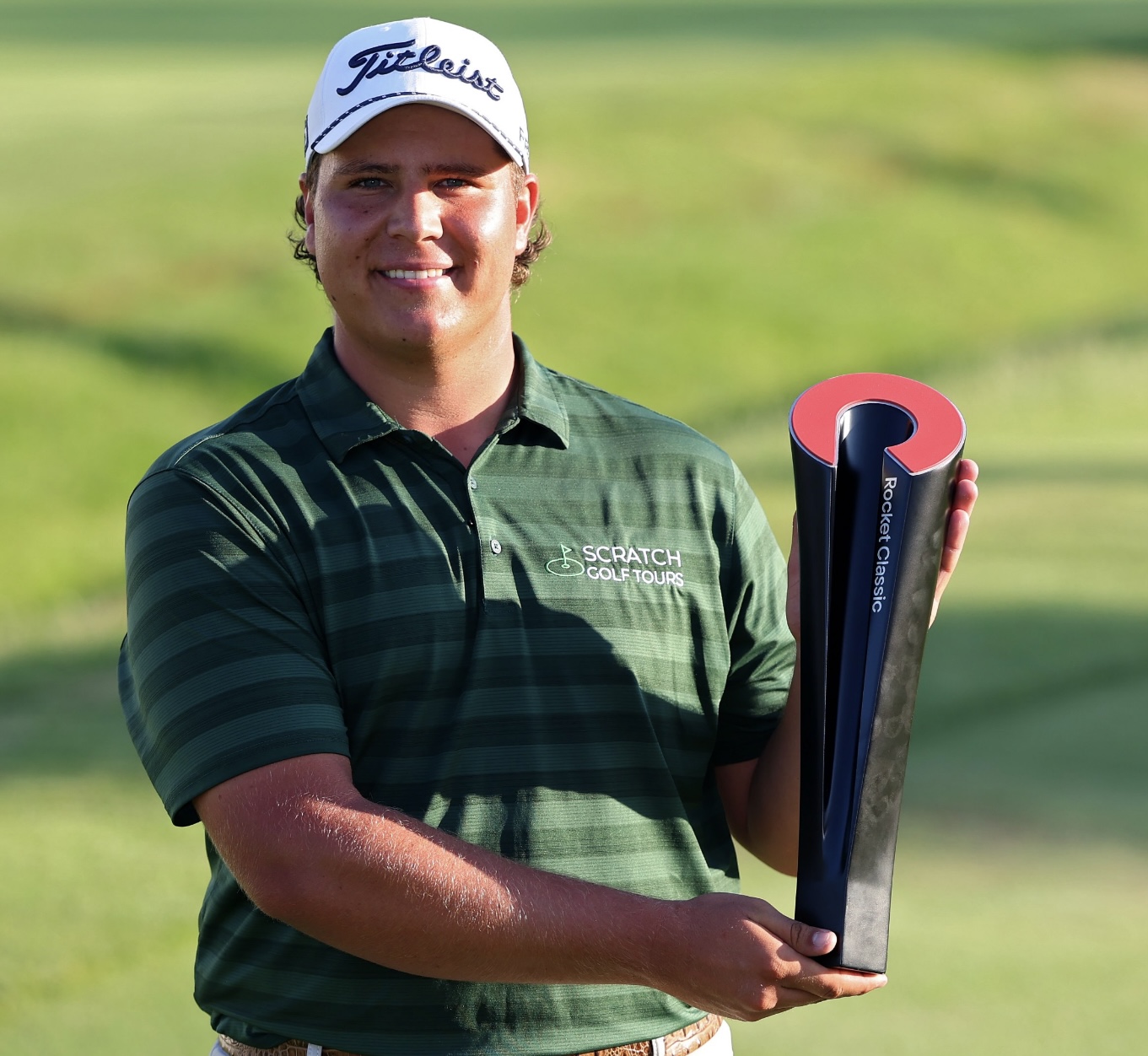
20-year old Aldrich got his first win at the Mortgage Rocket Classic after battling with his putter to grind out the victory.

South African born but growing up in Perth Australia, he turned professional at 18 after winning the Amateur Championship. He was the youngest winner on the Korn Ferry Tour and on the PGA Tour he leads in driving distance at 338.5 yards average and in strokes gained off the tee. A win after an up and down year where he missed nine cuts but also came second in Mexico.

The next big player in the new generation has arrived.

Posted in Uncategorized | Leave a comment

Open Final Qualifying

Screenshot

Just in from the R&A. Next year at the Open Championship there will be a “Last Chance Monday” with a winner takes all qualifier for up to 12 players to win a last gasp place in the Open.

Tomorrow is Final Qualifying for this year’s Championship at four courses – Burnham and Berriw, West Lancs, Dundonald Links and Royal Cinque Ports over 36 holes. Amongst the players will be lan Poulter and his son Luke aiming to be the first father and son to play in the Open since Christy O’Connor Jnr and Snr. Other notables competing are Lee Westwood, Adrian Meronck, Shubankar Sharma, Alex Fitzpatrick, Harry Hall, Anriban Lahiri. Erik van

Rooyenand Rasmus Petersen.

Good luck to everyone competing tomorrow.

Posted in Uncategorized | Leave a comment

And so we start again

It’s been sometime since I’ve posted here as most of my content went on to Instagram. 4,000 posts on there which came from a deep love of golf.

Last month, without warning and with no recourse to any appeal Meta decided to pull the plug on the account. 4,000 posts down the swanee.

WordPress support team, let me tell you, are lovely. They are so helpful and would never do anything so high handed and hurtful as to just whip the rug right under you without any reason or explanation. WordPress people are called happiness engineers.

Therefore, although I have started a new Instagram account – it is called @golf.we.love.it. Please follow if you would like to!

I’ll be coming back here because this is a safer space. Everytime I go to Instagram I have a trpidation that some faceless techie is going to catch me out on something. This isn’t fair. My accounts are about sport and seeing the fun in it. I am glad to get back to WordPress a happier space.

Posted in Uncategorized | Leave a comment

How to play the perfect pitch

Pitching doesn’t come naturally to many golfers because you are playing with a less than full swing. You also need to have a feel for distance, how far to hit the ball – and feel is an intuitive and inexact part of golf.

Many golfers only practice their full swing and neglect short game practice. Not practicing the pitch shot from 50 metres in means that it will be very difficult to execute this shot confidently on the golf course. A full swing is easier to master as it is a repetitive action for each club to make the ball go the maximum distance. But with a pitch shot you are not hitting the ball the maximum distance, So you must shorten the swing but still hit the ball firmly.

To pitch well you need to set up correctly and make a firm swing that accelerates the clubhead through the ball. You have to think in terms of a less than full backswing. One common error with this shot is taking the club too far back and decelerating through impact, which cases mis hits, 

You need to play the pitch shot with as little spin as possible because spin makes it harder to control the ball. Pitching the ball with control and finesse over a hazard and near to the pin is a very satisfying skill. 

Addressing the ball

Take a narrow stance, closer to the ball and open with your left foot behind the right. Open up 20 degrees so your left side is out of the way through the shot. Move your body weight onto the left foot and centre the weight forward onto the balls of the feet. Knees are flexed and the back bent over so the arms hang loosely from the upper body over the ball. The arms then can move freely without touching the upper body during the shot. 

Remember not to stand too tall, you need to have the upper body hanging over the ball. For consistent pitch shots you want good balance and good timing. Keep the knees bent. Move the weight back from the toes onto the balls of the feet. With flexed knees you can transfer the weight properly during the swing.

Firm wrist action

The best short game players use very little hand and wrist action. Try to overuse your hands and imagine them tied together on the club. Start the takeaway with your hands and arms as a unit moving together. Only when the right elbow starts to bend will the wrists hinge.

Try to keep the grip on the club light. It will help you with feel. Only firm enough to prevent the club from slipping in your hands. You will need a good body weight transfer to keep your wrists firm and prevent you from overusing the hands.

Proper weight transfer

Ideally, the lower body will move in time with the arms and hands. The lower body must move to keep the path of the club consistent through impact. Your hips and knees must be used in the swing. 

The weight, which starts on the left foot, transfers onto the right foot and back to the left foot during the swing in a rocking motion. The hit of the ball happens during the transfer of weight from the right foot to the left foot. Keep the clubface square through impact. The hips and elbows return to their original position as you hit through the ball, synchronising the motion of arms and lower body. 

Accelerate the clubhead

The pitch shot is a crisp hit – make sure that you accelerate the club through the impact zone. To do this make sure the swing is of equal length – swing the club back the same length as you swing it through. Clubhead speed comes from a proper weight transfer. It’s an underhanded motion with the right hand and arm through the impact zone. It’s the same movement as when you throw a ball underhand. 

Keep the right elbow tucked in

Keep the right elbow close to your body during the downswing. On the backswing because you are turning your shoulders the elbow will swing free but on the downswing the right elbow brushes across the hip coming into the ball. Visualise the shot as part of your pre shot routine see the spot where you want the ball to land on the green. You can walk up and survey your landing area on the green before you play your shot. 

Practising pitching

Pitch to different targets at different distances, starting with the shortest shot and ending with the longest. Vary the trajectory of the ball flight – try using a sand wedge and then work through the different wedges. Practice from poor lies to see how the ball flies out of the rough, so that when you’re out on the golf course you’ll be prepared for a variety of situations. Try playing different shots with your 9-iron and play a variety of different pitches with the same club. Try pitching over bunkers and over water hazards to increase your repertoire of shot making skills which will help lower your score.

Posted in Uncategorized | Leave a comment

What’s so special about Ludvig Aberg?

What’s so special about Ludvig Aberg?

It’s now a year since Ludvig Aberg turned pro and in that year he has won over $10,000,000 in prize money, winning on the DP World Tour and PGA Tour. He’s played an important part in a winning Ryder Cup team, had top 10s in majors and reached number 3 in the world. Rory McIlroy calls him an “unbelievable ball striker”.

Standing at 6 feet 3 inches, he stands close to the ball to maintain his height.  His grip has a very strong left hand to control the clubface and the weak left hand controls the loft of the club.

His stance has his armpits over the balls of his feet in a relaxed position. He starts the takeaway with a hip sway to the right moving the weight back early in the swing. This stops him moving too much ahead of the ball.

The wide arc of the club stays outside the line of the swing for a long time and the clubface stays closed. He keeps his hands high at the top of the swing. Not a big hip turn but a 90 degree shoulder turn. This restricted lower body turn generates power and speed.

He starts the downswing with a hip shift driving through with the left leg generating speed into the ball. His right arm extends with a huge roll of the wrists releasing power from the body into the clubhead. Huge body extension into the follow through.

He hits the ball high and far and then slows to a well balanced finish.

What’s in his bag?

DRIVER: Titleist TSR2 (9 degrees), with Fujikura Ventus Black 6 X shaft

FAIRWAY WOODS: TaylorMade Stealth 2 (15 degrees), with Fujikura Ventus TR Blue 8 X; (21 degrees), with Fujikura Ventus TR Blue 9 X

IRONS: Titleist T100 (4-PW), with KBS Tour 130 X shafts

WEDGES: Titleist Vokey Design SM10 (50, 54 and 60 degrees), with KBS Tour 130 X shafts

PUTTER: Odyssey White Hot Versa #1

BALL: Titleist Pro V1x

Posted in Uncategorized | Leave a comment

How the type of grass affects how you play

A golf writer once said that the most boring interview he ever sat through was a great player going on and on about the pros and cons of playing on poa annua grass. So, this is a test to see how soon your eyes glaze over as we have a look at some of the most common types of grass grown on golf courses. 

A course’s grass substantially affects how it plays, so let’s have a look at the playing characteristics of common grasses.

Course designers choose grasses that will thrive in the course’s particular environment.

You will often find fescue on seaside links courses. It’s a hardy, drought resistant grass that is easy to maintain and requires less watering. 

Bentgrass is normally found on courses with cooler temperatures, Inmountain areas ryegrass is often the choice. In warmer temperatures Bermuda grass.

It’s useful to recognise different golf course grasses to understand their playing characteristics, the fairway lies and the challenges they pose in the rough. 

It’s also important from a shot-making point of view to know how each grass type affects your lie and the action of the clubhead on the ball. Here are some of the main grasses:

Bent grass: This is a cool season grass with a fine leaf blade texture that is used mostly for fairways. Bent grass doesn’t thrive in hot and humid conditions and requires steady watering. On the fairways it produces tight lies. Bent grass isn’t used in the rough as it is a fine bladed grass.

Bermuda grass: A warm weather grass with broad, coarse leaf blades, it is used on both fairways and rough and grows well in tropical climes. It grows well in hot and humid conditions thriving on less water than bent grass. When maintained at fairway height Bermuda grass allow the ball to sit up well and provides a little clubhead resistance. In the rough Bermuda is stiff and wiry and will grab or twist a clubhead.

Poa Annua: This grass thrives under moist conditions. It often grows alongside fescue or bent grass. Agronomists think that it grows 40 percent quicker than bent grass and produces patchy, non-uniform fairways and rough areas. It has a short life cycle, appearing in the Spring. It has a sticky, clumpy irregular quality and because it is so fast growing and growing alongside other grasses it provides an unpredictable playing surface, particularly around the collar of the greens.

Fescue: This cool season grass has a coarse leaf blade texture and thrives by the sea. It is often found on British Isles courses and is associated with links courses. A finer version of fescue is often used by designers for the rough grass as it is easier to escape from than other cool season grasses such as blue grass tall fescue is useful as a rough grass and produces a contrast with the fairways. Fine fescue on the fairways provides a firm lie which makes the ball travel shorter distances.

Kikuyu Grass: This all season grass found on the West coast of America; it has a thick wiry blade. As a rough grass, kikuyu’s strong wiry texture will grab the clubhead. If left unmaintained it is a very difficult grass to escape from.

Ryegrass: is a cool season grass thriving under most conditions except heat and humidity. It grows quickly and is often used to overseed Bermuda grass fairways and rough areas in the winter months. As a fairway surface, ryegrass produces lush grass in a short period of time because it holds moisture well. Used for rough grass it can cause clubhead resistance.

Posted in Uncategorized | Leave a comment

Playing in the wind

There are four types of wind to be concerned about: tailwinds, headwinds, crosswinds and quarter winds. Each will influence your shot in a different fashion. 

A tailwind comes from behind you and blows in the general direction of your target. Spin on the ball will have less effect and it will be difficult to shape your shots by fading or drawing them. A tailwind also generally causes your shot to carry farther, especially if you get extra loft on it.

A headwind blows directly towards yiu from your target and will amplify the effects of spin. A draw or a fade will curve more than would otherwise be the case, and shots will often balloon, reducing carry. Consider using a less lofted club or playing the ball on a lower trajuectory. Don’t let a strong headwind intimidate you into overswinging.

A crosswind cuts across your line in a perpendicular fashion and will cause the ball to move to the right or left. Gauge the wind’s intensity and decide how far right or left to start the shot so the wind will push it to the target area.

A quartering wind blows toward you and cuts acriss your shot line at an angle. You will have to make both headwind and crosswinf adjustments.

When you are playing in windy conditions, you should think about your next move, Ascertain how the wind will affect the way you play the shot following the one you are about to hit. When you are putting you should carefully observe wind conditions because a strong wind can substantially affect a putt’s path to the hole. Experience and your sensitivity to this type of situatiin will enable you to develop putting touch in windy conditions. 

Wind can play havoc with your game. When you are playing in difficukt wind conditions everyone’s score will go up, Remember the advice “when it’s breezy, swing easy”.

So, how do course architects factor in the wind when designing a course? 

Wind is like an invisible hazard on the golf course. When the architect designs the course wind conditions play a material part in how the course is laid out. Prevailing, seasonal and even storm wind patterns are taken into account. They will influence the route of the holes and the configuration of features of the course. 

If the prevailing wind blows from east to west, the way that the fairways slope will minimise the prevailing wind’s effect. Greens might be tipped from west to east to counteract the east-west prevailing wind. A long par 4 wouldn’t be laid out in the position where it plays into a prevailing wind as it would play too long.

Sometimes seasonal and storm winds that blow in different directions other than the prevailing wind presenting a formidable playing challenge. Take extra care to determine if the wind is coming from an unusual direction and factor this in to your playing strategy. If you’re playing away from your home course taking the advice of the club professionals before your round is 10 minutes time well spent so that you know the wind direction on each hole.

Posted in Uncategorized | Leave a comment

Greeting the players at the Scottish Open

Posted in Uncategorized | Leave a comment